


The biography of Albert Einstein is the story of one of the most influential theoretical physicists in modern history. Born in Germany in 1879, Einstein developed ideas that changed scientific understanding of space, time, light, gravity, and the relationship between mass and energy.
Although many people know him because of the famous equation E = mc², his scientific contribution was much broader. His work included special relativity, general relativity, the photoelectric effect, Brownian motion, and important contributions to the development of modern physics.
Einstein’s life was also shaped by major historical events. He lived and worked in Germany and Switzerland, moved to the United States after the rise of Nazi Germany, and spent the later part of his career at the Institute for Advanced Study in Princeton, New Jersey.
This article explores Einstein’s early life, education, career, scientific discoveries, Nobel Prize, move to America, and lasting legacy.
Early Life of Albert Einstein 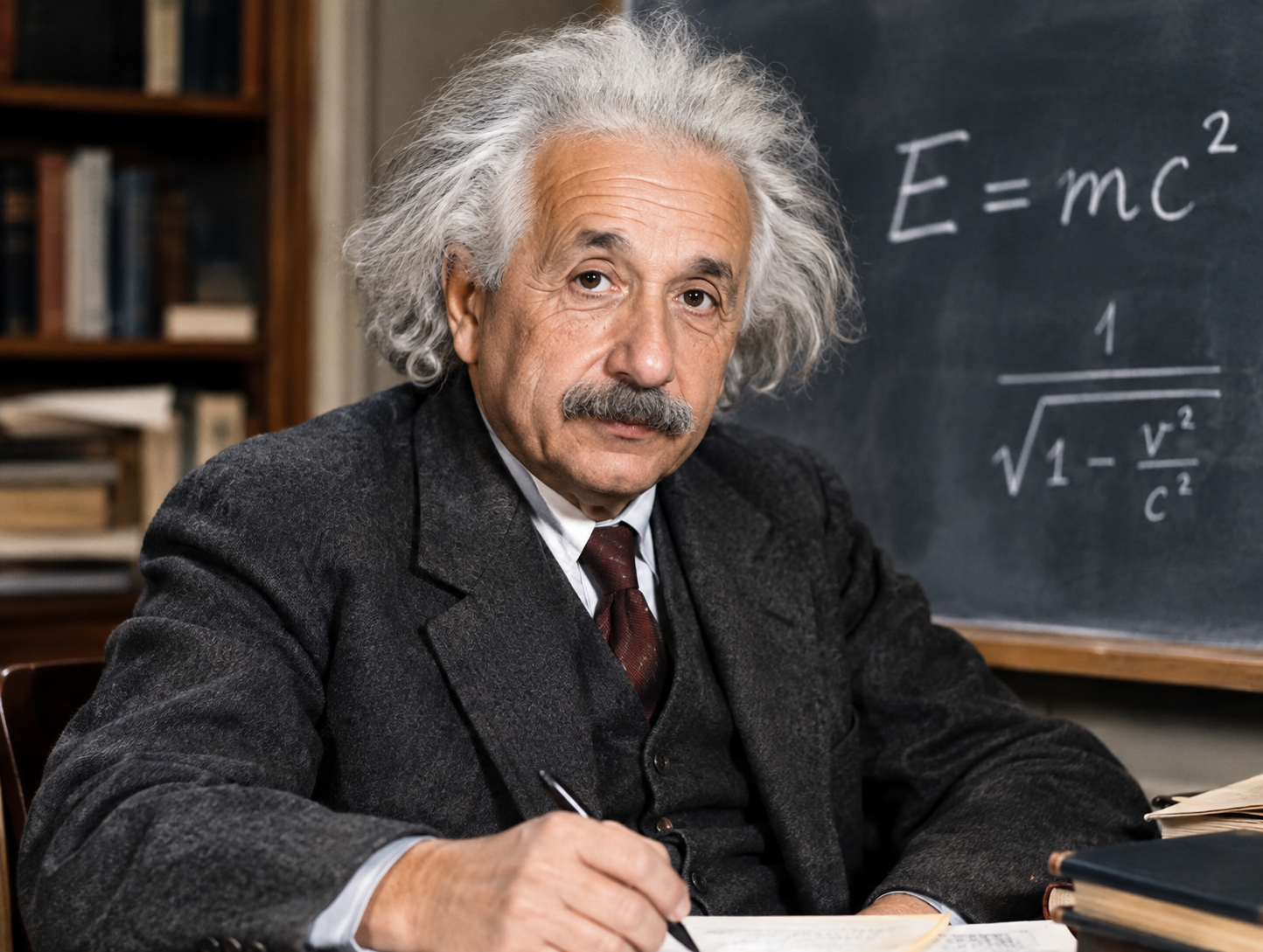
Albert Einstein was born on March 14, 1879, in Ulm, in the Kingdom of Württemberg, which was then part of the German Empire.
His parents were Hermann Einstein and Pauline Einstein. The family later moved to Munich, where Einstein spent part of his childhood.
As a young person, Einstein developed a strong interest in mathematics and science. His curiosity about scientific questions became an important part of his intellectual development.
Einstein’s education was not completely straightforward. He eventually moved to Switzerland and studied at the Swiss Federal Polytechnic in Zurich, now known as ETH Zurich.
His experiences as a student helped prepare him for a career in theoretical physics.
Education and Early Career
Einstein graduated from the Swiss Federal Polytechnic in 1900.
After graduation, he initially had difficulty finding an academic position. In 1902, he began working at the Swiss Patent Office in Bern.
His job involved examining patent applications. Outside his professional duties, however, Einstein continued thinking about important questions in physics.
This period became particularly significant because he developed several ideas that later transformed modern physics.
Einstein’s early career is also a reminder that scientific careers do not always develop through a simple or predictable path.
The Biography of Albert Einstein and the Extraordinary Year 1905
The year 1905 was a turning point in Einstein’s scientific career.
During that year, he published several important scientific papers while still working at the Swiss Patent Office.
These papers addressed different problems in physics and helped establish his reputation among scientists.
Einstein and the Photoelectric Effect
One of Einstein’s important contributions concerned the photoelectric effect.
He proposed an explanation based on the idea that light transfers energy in discrete quantities. This work became an important contribution to the development of quantum theory.
Einstein was later awarded the 1921 Nobel Prize in Physics for his contributions to theoretical physics, particularly his discovery of the law of the photoelectric effect.
You can learn more about the award from the official Nobel Prize biography and information about Albert Einstein.
Special Theory of Relativity
Einstein also published his famous work on special relativity in 1905.
Special relativity changed scientific understanding of space and time. It showed that measurements of time and space can depend on the relative motion of observers and established the speed of light in a vacuum as a fundamental constant.
The theory became one of the foundations of modern physics.
E = mc²
Einstein’s work also established the relationship between mass and energy commonly represented as:
E = mc²
In this equation, E represents energy, m represents mass, and c represents the speed of light.
The equation demonstrates that mass and energy are related. Because the speed of light is extremely large, even a relatively small amount of mass corresponds to a very large amount of energy.
The equation became one of the most recognizable mathematical expressions in science.
Einstein and General Relativity
Einstein continued developing his ideas about gravity after his work on special relativity.
In 1915, he presented the general theory of relativity.
General relativity provided a new way of describing gravity. Instead of treating gravity simply as a conventional force, Einstein’s theory connected gravity with the geometry of spacetime and the distribution of matter and energy.
The theory made predictions that could be tested through observations.
One famous example involved the bending of light by gravity. Observations during the 1919 solar eclipse were interpreted as supporting a prediction of Einstein’s theory, contributing to his growing international reputation.
Today, general relativity remains an important part of modern physics.
For additional scientific background, readers can consult the Institute for Advanced Study’s information about Albert Einstein.
Albert Einstein’s Academic Career
Einstein’s career gradually moved from the Swiss Patent Office into academic and research positions.
In 1909, he became an associate professor at the University of Zurich.
He later worked in Prague and returned to Zurich before moving to Berlin in 1914.
Berlin became an important period in Einstein’s scientific career. He was able to devote substantial attention to theoretical physics and continued developing his work on relativity and other areas of science.
His international reputation continued to grow during this period.
The Nobel Prize in Physics
Albert Einstein received the Nobel Prize in Physics for 1921.
The Nobel Prize recognized his services to theoretical physics and specifically highlighted his discovery of the law of the photoelectric effect.
It is important to distinguish this from a common misconception: Einstein did not receive the Nobel Prize specifically for the theory of relativity.
The official Nobel Prize record provides the most reliable information about the award and its citation.
Einstein’s Life During Political Change
The biography of Albert Einstein cannot be separated completely from the political events of twentieth-century Europe.
Einstein was openly associated with pacifist and humanitarian causes and became a public figure beyond the scientific community.
The political situation in Germany changed dramatically after the Nazis came to power in 1933.
Because of his Jewish background and public positions, Einstein faced hostility and persecution in Nazi Germany.
He left Germany and eventually settled in the United States.
This period also affected many other European scientists and intellectuals who left their countries because of political persecution.
Einstein Moves to the United States
In 1933, Einstein joined the Institute for Advanced Study in Princeton, New Jersey.
The institution became his professional home for the remainder of his life.
The Institute for Advanced Study’s official Einstein collection provides historical information about his work and time at the institution.
In the United States, Einstein continued working on theoretical physics.
He remained particularly interested in finding a deeper unified description of physical laws.
Although he did not achieve the unified theory he hoped to develop, his efforts demonstrated his continued interest in fundamental questions about nature.
Einstein and Nuclear Weapons
Einstein’s name is sometimes directly associated with the development of the atomic bomb, but his actual role requires careful explanation.
In 1939, Einstein signed a letter addressed to U.S. President Franklin D. Roosevelt warning about the possibility that Nazi Germany could develop nuclear weapons.
The letter helped bring attention to the potential military significance of nuclear research.
However, Einstein was not a member of the Manhattan Project and did not directly participate in the development of the atomic bomb.
In later years, he publicly supported efforts related to peace, international cooperation, and reducing the danger posed by nuclear weapons.
Albert Einstein’s Personal Life
Einstein’s personal life included two marriages.
He married Mileva Marić, whom he met while studying in Zurich. They had children and later separated.
In 1919, Einstein married Elsa Einstein.
His personal relationships were sometimes complicated, and his professional life involved substantial intellectual and public responsibilities.
Examining this part of his life provides a more complete picture of the person behind the famous scientific reputation.
Einstein’s Later Years
During his later years at Princeton, Einstein continued working on theoretical physics.
He remained interested in fundamental questions about the structure of nature and continued searching for a unified framework for physical laws.
He also participated in public discussions about peace, civil liberties, international cooperation, and the dangers of nuclear weapons.
In 1940, Einstein became a U.S. citizen.
In 1952, he was offered the presidency of Israel but declined the position.
Einstein continued working and writing until shortly before his death.
Death of Albert Einstein
Albert Einstein died on April 18, 1955, in Princeton, New Jersey.
He was 76 years old.
By the time of his death, his scientific work had already become an important part of modern physics.
His theories and discoveries continued to influence scientific research after his death.
Major Scientific Contributions of Albert Einstein
The biography of Albert Einstein includes several major scientific contributions.
Special Relativity
Special relativity changed the scientific understanding of space and time and established important relationships between observers moving relative to one another.
General Relativity
General relativity provided a new mathematical description of gravity and spacetime.
Photoelectric Effect
Einstein’s explanation of the photoelectric effect helped establish the idea that light can transfer energy in discrete amounts.
Brownian Motion
Einstein’s work on Brownian motion provided important theoretical support for the existence of atoms and molecules.
Mass-Energy Equivalence
His famous equation E = mc² expressed the relationship between mass and energy.
These contributions affected multiple areas of physics and helped shape later scientific research.
Why Albert Einstein’s Work Still Matters
Einstein’s scientific legacy continues to be studied because his theories remain important to modern physics.
His work contributed to the development of ideas used in areas such as cosmology, astronomy, particle physics, and gravitational research.
His story is also useful from an educational perspective.
Einstein’s career demonstrates the importance of questioning assumptions, examining evidence, developing mathematical explanations, and remaining willing to explore difficult scientific problems.
However, his story should not be reduced to the idea that one person simply changed science alone. Modern scientific knowledge develops through the work of many researchers over long periods of time.
Important Dates in Einstein’s Life
| Year | Event |
|---|---|
| 1879 | Albert Einstein was born in Ulm, Germany |
| 1900 | Graduated from the Swiss Federal Polytechnic |
| 1902 | Began working at the Swiss Patent Office |
| 1905 | Published several major scientific papers |
| 1909 | Became an associate professor at the University of Zurich |
| 1915 | Completed the general theory of relativity |
| 1921 | Awarded the Nobel Prize in Physics |
| 1933 | Moved to the United States |
| 1933 | Joined the Institute for Advanced Study in Princeton |
| 1940 | Became a U.S. citizen |
| 1952 | Declined the presidency of Israel |
| 1955 | Died in Princeton, New Jersey |
Frequently Asked Questions
1. Who was Albert Einstein?
Albert Einstein was a German-born theoretical physicist whose work made major contributions to modern physics, particularly relativity, the photoelectric effect, Brownian motion, and the relationship between mass and energy.
2. What is Albert Einstein most famous for?
Einstein is most widely known for the theories of special and general relativity and the equation E = mc². He was also awarded the Nobel Prize for his work on the photoelectric effect.
3. When was Albert Einstein born?
Albert Einstein was born on March 14, 1879, in Ulm, in the German Empire.
4. Why did Albert Einstein move to the United States?
Einstein left Germany in 1933 after the Nazis came to power. The political environment had become hostile toward him and other Jewish people, and he subsequently established his career in the United States.
5. Where did Albert Einstein work in America?
Einstein worked at the Institute for Advanced Study in Princeton, New Jersey, beginning in 1933. He remained associated with the institution until his death in 1955.
Conclusion
The biography of Albert Einstein shows how a curious young student became one of the most influential theoretical physicists of the twentieth century. His journey included education in Switzerland, work at the Swiss Patent Office, major scientific publications in 1905, the development of relativity, the Nobel Prize, and a later career in Princeton.
His achievements extended beyond the famous equation E = mc². His work on light, motion, gravity, spacetime, and mass-energy relationships contributed significantly to modern physics.
Einstein’s life also took place during periods of major political and social change. His experiences in Europe and later in the United States demonstrate how science and history can become closely connected.
For readers interested in science and history, studying Einstein’s life offers an opportunity to understand both the development of modern physics and the human story behind some of its most influential ideas.