


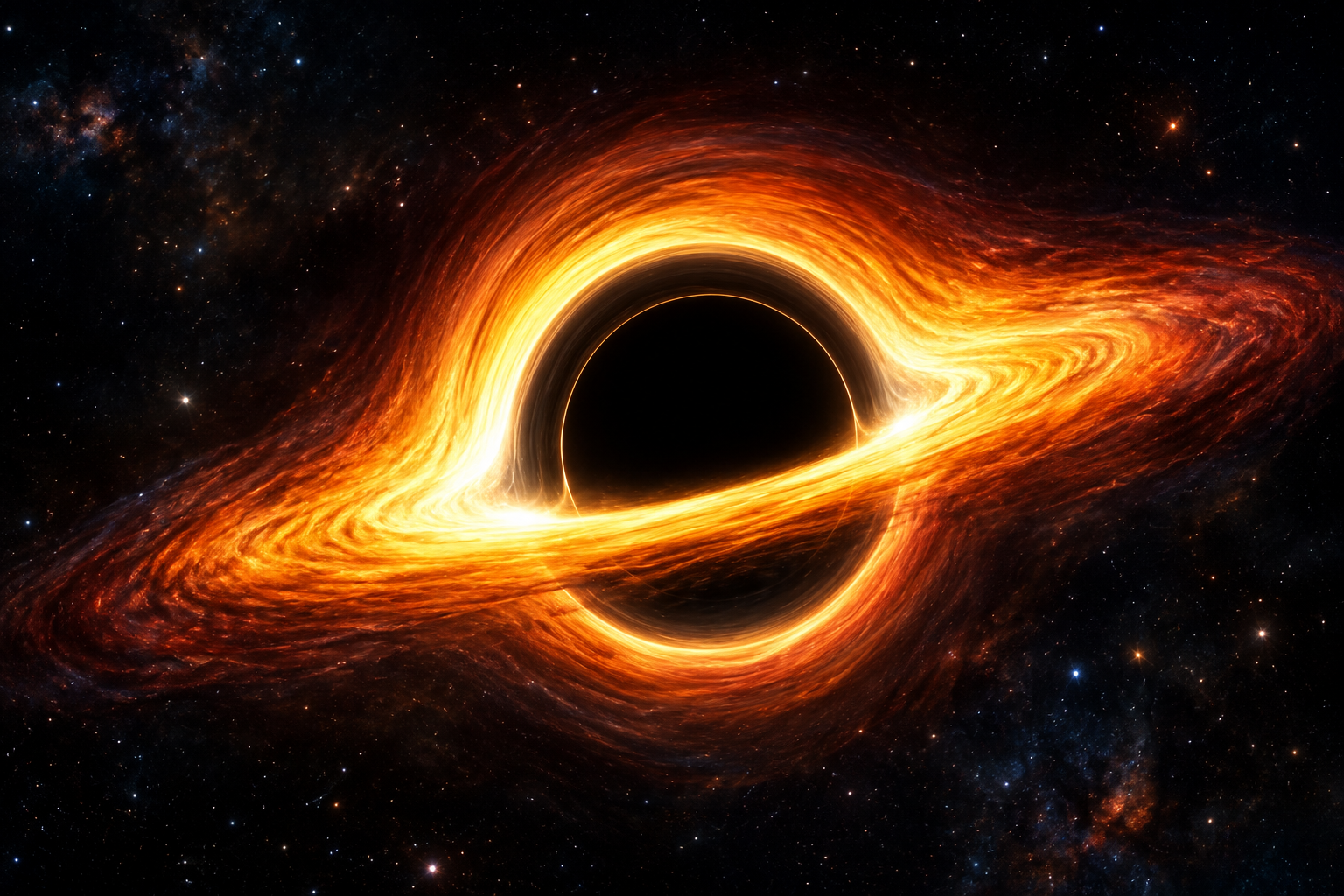
The universe contains many extraordinary objects, but few are as fascinating as a black hole. These regions of space have such extreme gravitational effects that, once something passes beyond the event horizon, it cannot escape to the outside universe—not even light.
Despite their mysterious reputation, black holes are not simply cosmic holes that travel through space and swallow everything around them. They are physical objects associated with enormous amounts of mass concentrated into extremely compact regions.
Scientists study black holes by observing how they affect nearby stars, gas, light, and even spacetime itself. Modern astronomy has provided several remarkable ways to investigate them, including X-ray observations, gravitational-wave detectors, and radio observations made by the Event Horizon Telescope.
In this guide, you will learn what a black hole is, how it forms, what happens around it, how astronomers detect it, and why these objects are so important to our understanding of the universe.
What Is a Black Hole? 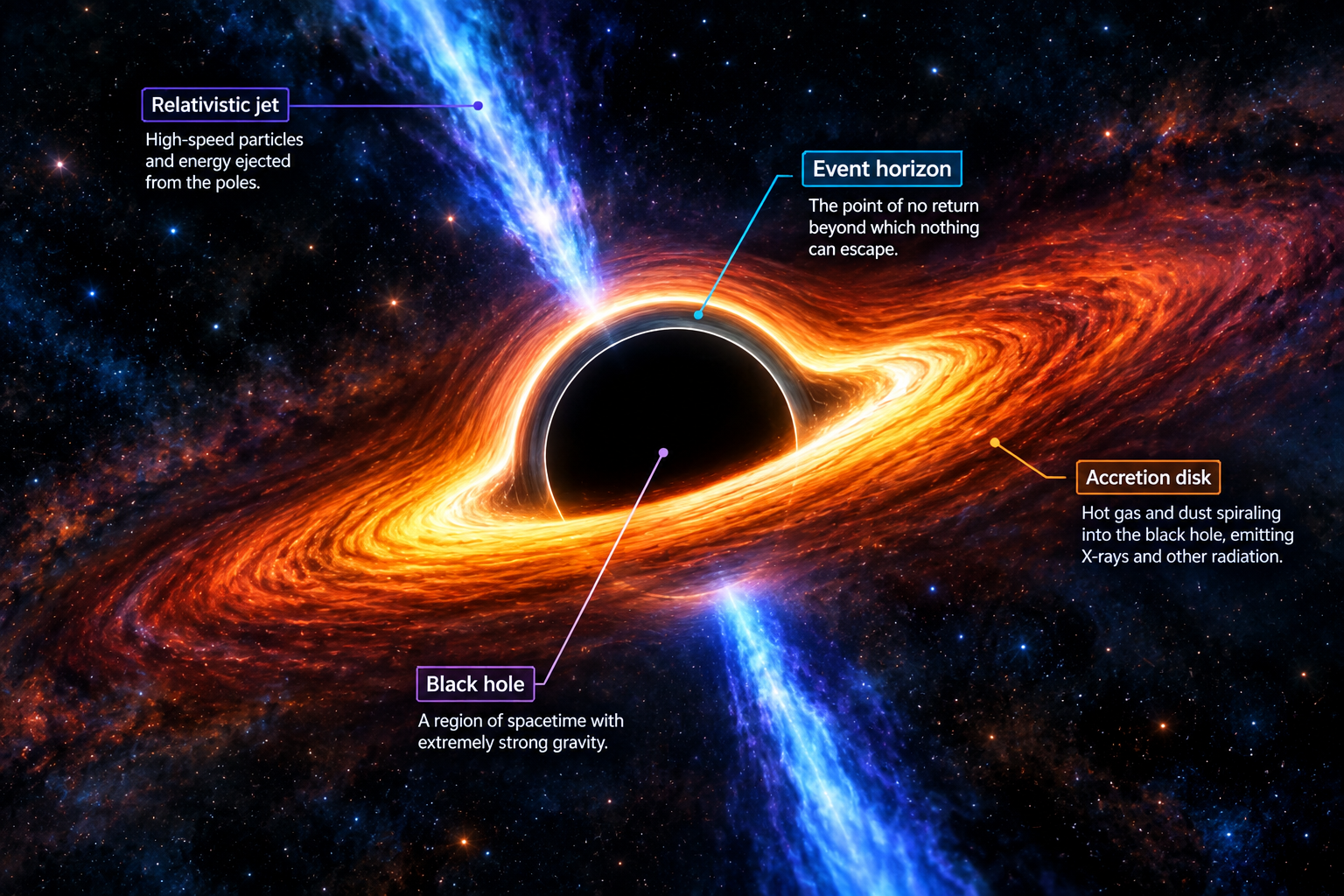
A black hole is a region of spacetime where gravity becomes extraordinarily strong.
According to Einstein’s general theory of relativity, massive objects affect the structure of spacetime. When a sufficiently large amount of matter becomes concentrated in a small enough region, the resulting gravitational field can become so strong that an event horizon forms.
The event horizon is the boundary beyond which escape is impossible according to our current understanding of physics.
Importantly, a black hole is not an ordinary hole or empty space. NASA explains that black holes are concentrations of matter packed into extremely small regions, with an event horizon marking the boundary from which light cannot escape.
For a detailed scientific introduction, readers can explore the NASA Black Holes guide.
How Does a Black Hole Form?
There is more than one pathway through which black holes can form.
Stellar-Mass Black Holes
One of the best-known formation processes begins with a massive star.
Stars spend much of their lives producing energy through nuclear fusion. This energy helps support the star against the inward pull of gravity. When a sufficiently massive star reaches the later stages of its life, its internal balance can change dramatically.
The core can collapse under its own gravity. Depending on the mass and physical conditions of the remaining core, the result can be a neutron star or a black hole.
NASA’s explanation of how different types of black holes form provides more detail about stellar-mass black holes and their origins.
Not every massive star necessarily produces the same final object. Stellar evolution is complex, and the final result depends on several factors, including the star’s mass and how much material remains during its collapse.
Supermassive Black Holes
A much larger category consists of supermassive black holes.
These objects can contain millions or billions of times the mass of the Sun and are associated with the centers of many large galaxies.
The Milky Way, for example, contains a supermassive black hole called Sagittarius A* at its center.
Scientists are still investigating how the earliest supermassive black holes formed and grew so rapidly in the early universe. Observations of distant galaxies continue to provide new information about their origins.
The European Space Agency’s overview of black holes provides additional information about their formation, growth, and effects on their surroundings.
What Is the Event Horizon?
The event horizon is one of the most important features of a black hole.
It is the boundary surrounding a black hole beyond which information cannot escape to a distant observer.
The event horizon should not be imagined as a solid wall. It is a boundary created by the geometry of spacetime.
Once an object crosses it, there is no known path that allows the object to return to the outside universe.
This is also why black holes appear dark. Light produced inside the event horizon cannot travel outward and reach a distant observer.
NASA provides a useful explanation of the anatomy of a black hole, including the event horizon, accretion disk, jets, and other features.
Why Can’t Light Escape From a Black Hole?
Light travels at the fastest speed permitted by modern physics. However, the region inside a black hole’s event horizon is not simply an area where gravity acts like an ordinary force pulling light backward.
General relativity describes gravity in terms of curved spacetime.
Inside the event horizon, the structure of spacetime is such that all possible future-directed paths lead further inward. There is no route that allows light to travel back out to the external universe.
This is the fundamental reason black holes are black.
However, it is important to distinguish the black hole itself from its surroundings. Material outside the event horizon can become extremely hot and bright, allowing astronomers to observe the environment around a black hole even though the black hole itself does not emit visible light from within its event horizon.
What Happens Around a Black Hole?
The area surrounding a black hole can be extremely active.
Gas, dust, stars, and other material can interact with the black hole’s gravitational field. If gas loses enough energy and moves inward, it can form a rapidly rotating structure called an accretion disk.
What Is an Accretion Disk?
An accretion disk is a rotating disk of material surrounding a compact object.
As material moves inward, collisions and other physical processes can convert gravitational energy into heat and radiation. The resulting radiation can be detected by telescopes.
In some systems, the radiation is particularly strong at X-ray wavelengths.
This is one reason astronomers can identify black holes even though the black holes themselves are not directly visible.
NASA’s How Do We Know There Are Black Holes? explains how astronomers use surrounding stars, gas, radiation, and other evidence to identify black holes.
What Is Spaghettification?
One of the more unusual effects associated with black holes is commonly called spaghettification.
This term describes extreme tidal stretching.
Gravity becomes stronger as an object gets closer to a compact massive object. If the difference in gravitational strength between one part of an object and another becomes large enough, the object can be stretched along one direction and compressed along another.
The effect can be especially severe near smaller black holes.
The exact experience would depend on the size and mass of the black hole, the object’s trajectory, and its distance from the event horizon.
Therefore, popular descriptions of spaghettification should not be treated as a single identical experience for every black hole.
What Is Inside a Black Hole?
This is one of the areas where scientists must be especially careful.
Classical general relativity predicts that gravitational collapse can lead to a singularity. In simple terms, a singularity is a region where the mathematical description produces extreme conditions.
However, scientists do not yet have a complete theory combining general relativity with quantum mechanics in these extreme circumstances.
For that reason, the deepest interior of a black hole remains an important open problem in theoretical physics.
NASA also notes that the physical nature of the singularity remains uncertain and that it may indicate a limitation of our current description of gravity.
Different Types of Black Holes
Astronomers commonly discuss black holes according to their mass.
Stellar-Mass Black Holes
These are associated with the deaths of massive stars and generally have masses comparable to stellar objects.
Many known stellar-mass black holes have been identified through their interactions with companion stars.
If a black hole pulls gas from a nearby companion, the gas can form an accretion disk and produce detectable radiation.
Intermediate-Mass Black Holes
Intermediate-mass black holes occupy a proposed range between stellar-mass and supermassive black holes.
Scientists have found evidence for objects that may belong to this category, but their formation and population remain active areas of research.
Gravitational-wave observations are also helping scientists investigate black holes across a wider range of masses.
Supermassive Black Holes
Supermassive black holes are found at the centers of many large galaxies.
Their masses can reach millions or billions of times the mass of the Sun.
When large amounts of matter interact with a supermassive black hole, the surrounding region can become extremely energetic. Some systems also produce powerful jets of particles moving away from the central region.
How Do Scientists Detect a Black Hole?
Because a black hole does not emit ordinary visible light from inside its event horizon, astronomers usually identify one through its effects on its environment.
There are several important methods.
1. Observing Nearby Stars
A black hole can influence the motion of nearby stars.
If astronomers observe a visible star orbiting an invisible object with enormous mass, the invisible object may be a black hole.
This method has been especially important for studying the center of the Milky Way.
2. Observing Hot Gas
Gas falling toward a black hole can become extremely hot.
The resulting radiation can be detected using telescopes designed to observe different wavelengths, including X-rays.
This provides evidence about the black hole’s surroundings and the material interacting with it.
3. Detecting Gravitational Waves
Another major method is the detection of gravitational waves.
When two black holes orbit each other and eventually merge, they can produce waves that travel through spacetime.
In 2015, the LIGO detectors recorded gravitational waves from a binary black-hole merger. This observation opened a new way of studying black holes.
Readers interested in the scientific history of this discovery can explore the official LIGO explanation of the first black-hole gravitational-wave detection.
4. Observing the Black Hole’s Shadow
Scientists can also study the environment immediately surrounding a supermassive black hole.
In 2019, the Event Horizon Telescope collaboration released the first image of the shadow of the supermassive black hole in the center of the galaxy Messier 87.
The observation was a major achievement because the telescope network effectively used radio observatories around Earth to obtain an image at extremely high resolution.
The Event Horizon Telescope’s official report on the M87 black hole provides the scientific background behind the observation.
Sagittarius A*: The Black Hole at the Center of the Milky Way
Our galaxy has its own supermassive black hole.
It is called Sagittarius A*, often shortened to Sgr A*.
Astronomers had strong evidence for a massive compact object at the center of the Milky Way because stars near the galactic center were observed moving around an invisible central object.
In 2022, the Event Horizon Telescope collaboration released the first image of Sagittarius A*.
The image does not show the black hole’s interior. Instead, it shows the bright surrounding emission and the dark central shadow associated with the black hole.
You can read the official Event Horizon Telescope explanation of Sagittarius A* for more information.
Black Holes and Time
Black holes are also important because they demonstrate some of the unusual predictions of general relativity.
Gravity can affect how time passes relative to observers in different gravitational environments. This phenomenon is known as gravitational time dilation.
The stronger the gravitational field, the greater the potential difference in the rate at which clocks are observed to run relative to one another.
Near a black hole, these effects can become extreme.
However, descriptions of time near black holes are often simplified in movies and popular culture. The actual experience depends on the observer, their motion, their location, and the comparison being made.
Are Black Holes Like Cosmic Vacuum Cleaners?
No.
This is one of the most common misconceptions about black holes.
A black hole does not automatically pull in everything around it from enormous distances.
At a given distance, its gravitational influence depends on its mass just as gravity around other massive objects does.
If an object is sufficiently far away and remains in a stable orbit, it does not necessarily fall into the black hole.
The danger increases when an object gets close enough for the black hole’s gravitational environment to strongly affect its trajectory.
NASA specifically addresses this misconception in its explanation of what a black hole is not.
Black Hole vs. Neutron Star
Black holes and neutron stars are both extremely compact objects, but they have important differences.
| Feature | Black Hole | Neutron Star |
|---|---|---|
| Event horizon | Yes | No |
| Physical surface | No ordinary surface at the event horizon | Yes |
| Escape from the event horizon | Impossible | Not applicable |
| Can produce radiation from surroundings | Yes | Yes |
| Can result from stellar collapse | Yes | Yes |
| Extremely dense | Yes | Yes |
A neutron star has a physical surface made from extremely dense matter.
A black hole, by contrast, is defined observationally by its event horizon and extreme gravitational structure.
Can a Black Hole Destroy Earth?
There is no known black hole close enough to Earth to pose an immediate threat.
The supermassive black hole at the center of the Milky Way is extremely distant from our solar system.
More generally, a black hole does not automatically destroy planets simply because it exists. Its gravitational influence depends strongly on distance.
Astronomers continue to observe the universe using space telescopes, ground-based observatories, gravitational-wave detectors, and other instruments to better understand black holes and other compact objects.
For broader astronomy information, readers can also explore the NASA Science Universe section.
Why Are Black Holes Important?
Studying black holes helps scientists investigate some of the most extreme conditions in nature.
Black-hole research contributes to our understanding of:
- Gravity
- Spacetime
- Massive stars
- Galaxy evolution
- High-energy astrophysics
- Gravitational waves
- The limits of general relativity
- The relationship between gravity and quantum physics
Black holes are therefore not just mysterious astronomical objects. They are natural laboratories for testing some of the most fundamental ideas in modern physics.
Black Hole Research Is Still Developing
Although scientists have learned a great deal about black holes, many questions remain unanswered.
Researchers are still investigating how the first supermassive black holes formed, how black holes grow over cosmic time, how powerful jets are produced, and what the deepest interior of a black hole is physically like.
New observations continue to improve our understanding.
For example, gravitational-wave observatories provide information that cannot be obtained through ordinary light-based astronomy, while facilities such as the Event Horizon Telescope allow researchers to investigate regions extremely close to supermassive black holes.
This combination of different observation methods is helping astronomy develop a more complete picture of these extreme objects.
Frequently Asked Questions About Black Holes
What is a black hole in simple terms?
A black hole is a region of spacetime where gravity is extremely strong. Once an object crosses its event horizon, it cannot escape back to the outside universe.
How does a black hole form?
Some black holes form when the cores of massive stars collapse. Other black holes, particularly supermassive ones, have much more complex formation and growth histories that scientists continue to study.
Can we see a black hole?
The black hole itself cannot be seen in ordinary visible light because light cannot escape from inside its event horizon. Scientists can observe its effects on nearby matter, stars, radiation, and spacetime. The Event Horizon Telescope has also produced images of black-hole shadows.
What happens if something gets close to a black hole?
An object approaching a black hole can experience increasingly strong gravitational and tidal effects. Depending on the black hole’s mass and the object’s trajectory, tidal forces can eventually stretch and disrupt the object.
Is there a black hole at the center of the Milky Way?
Yes. The center of the Milky Way contains the supermassive black hole Sagittarius A*. Its presence has been supported by observations of stars orbiting the compact object at the center of our galaxy and by the Event Horizon Telescope’s 2022 image.
Conclusion
A black hole is one of the most extreme objects known in astronomy. It is not an ordinary hole in space, nor is it a cosmic vacuum cleaner. Instead, it is a region of spacetime where gravity becomes so strong that an event horizon forms, preventing anything inside that boundary from escaping to the outside universe.
Black holes can form through stellar collapse, while supermassive black holes occupy the centers of many galaxies. Scientists study them by observing nearby stars and gas, detecting gravitational waves, and examining the light and radio emission surrounding them.
The discoveries made through NASA missions, LIGO observations, and the Event Horizon Telescope have transformed our understanding of these objects. Yet important questions remain, particularly about their deepest interiors and the origins of the earliest supermassive black holes.
For readers interested in astronomy and the wider universe, black holes offer an excellent example of how observation, mathematics, and modern technology work together to explore phenomena that cannot be studied directly from Earth.
For more educational science and technology content, visit Kaskeymarketer.com.
Friends, here you can find a sensitive topic regarding Alian; click here to read it. https://kaskeymarketer.com/aliens-life-beyond-earth/