


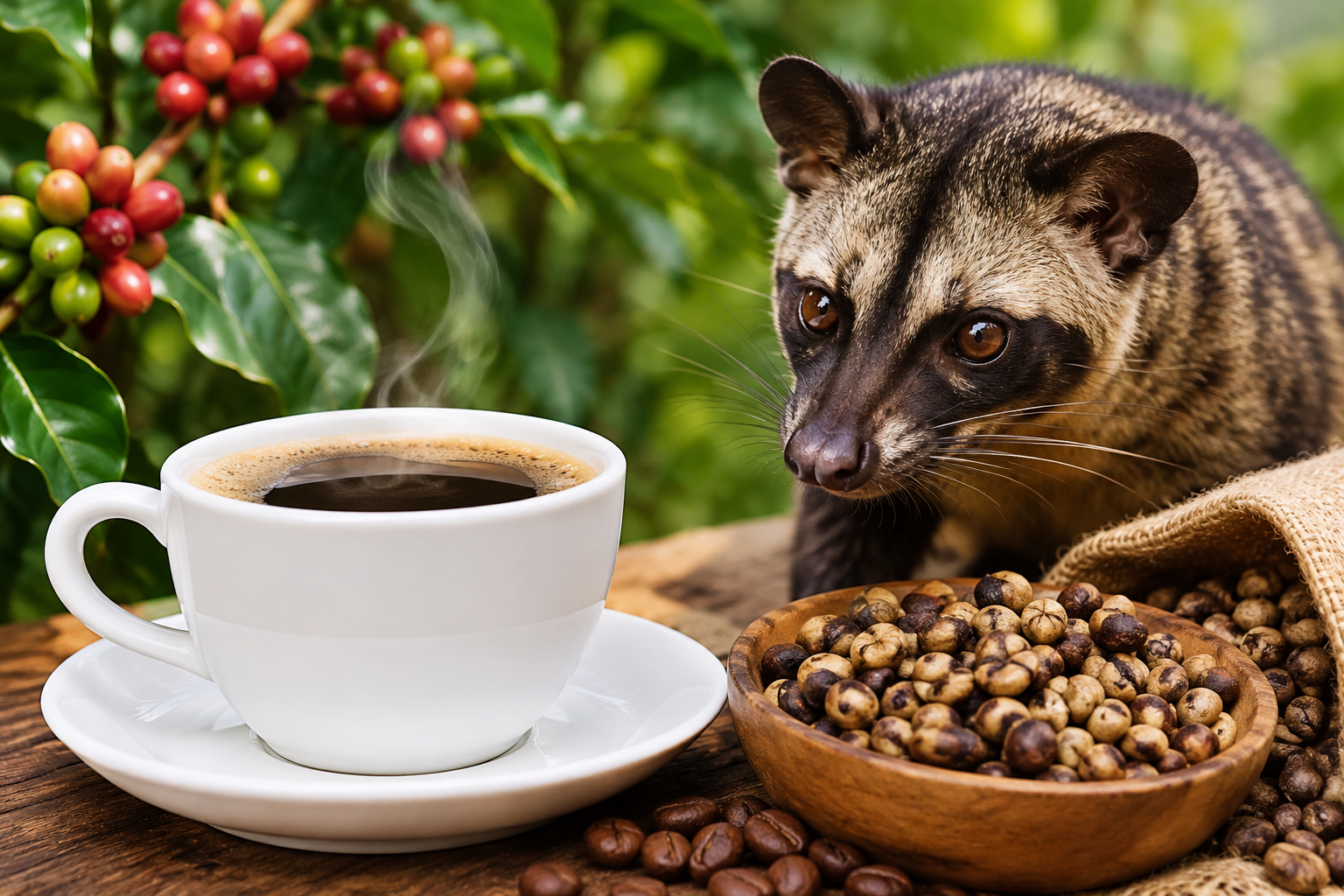
Kopi luwak is one of the world’s most unusual and well-known specialty coffees. Also called civet coffee, it is traditionally produced from coffee beans that have passed through the digestive system of a civet before the beans are collected, cleaned, dried, roasted, and brewed.
Its unusual production process has made kopi luwak famous among coffee enthusiasts and curious consumers. However, there is much more to understand than its reputation and price. Questions about its taste, production, authenticity, cost, and animal welfare are important when learning about this distinctive coffee.
In this guide, you will learn what kopi luwak is, how it is made, why it can be expensive, what it tastes like, and what to consider before buying it.
What Is Kopi Luwak?
Kopi luwak is coffee made from coffee beans that have been eaten and later excreted by civets.
The word “kopi” means coffee, while “luwak” is a name commonly associated with civets in Indonesia. The Asian palm civet is particularly associated with traditional kopi luwak production.
Civets naturally eat ripe coffee cherries. The fruit is digested, while the coffee seeds inside the cherries pass through the animal’s digestive system. During this process, the beans can be exposed to digestive enzymes and microorganisms that may affect their chemical characteristics.
After the beans are collected, they must be thoroughly cleaned, dried, processed, and roasted before they can be used to make coffee.
If you are interested in learning about other varieties, you can also explore our guide to [Coffee Types and Their Differences].
How Is Kopi Luwak Made?
The production of kopi luwak involves several important stages.
1. Civets Eat Ripe Coffee Cherries
Civets may eat ripe coffee cherries when they encounter them in coffee-growing areas. The quality of the cherries can influence the resulting coffee because coffee flavor is affected by the quality and maturity of the fruit.
2. The Coffee Beans Pass Through Digestion
The coffee seeds inside the cherries pass through the civet’s digestive system.
During digestion, the beans can be exposed to enzymes, acids, and microorganisms. These interactions may change some of the compounds associated with the coffee.
This is one of the main reasons kopi luwak has attracted scientific and commercial interest.
3. The Beans Are Collected
After being excreted, the coffee beans are collected.
At this point, the beans are obviously not ready to drink. They require careful cleaning and processing before they can be used.
4. The Beans Are Cleaned and Dried
The collected beans are cleaned to remove remaining material and then dried.
Proper sanitation and handling are particularly important because the beans have been in contact with animal waste.
5. The Beans Are Roasted
Once properly processed and dried, the beans are roasted.
Roasting develops the aroma and flavor that people associate with coffee. The final taste can vary depending on the coffee variety, origin, processing method, roasting level, storage, and brewing technique.
For more information about this stage, read our [Complete Guide to Coffee Roasting].
What Does Kopi Luwak Taste Like?
People often ask whether kopi luwak tastes different from regular coffee.
There is no single flavor profile that describes every kopi luwak. Taste can vary significantly depending on where the coffee was grown, the coffee variety, processing, roasting, freshness, and brewing method.
Kopi luwak is sometimes described as smooth with relatively low perceived bitterness. However, these descriptions are subjective, and individual coffees can taste very different.
For some coffee drinkers, the main attraction is the unusual production process and history. Others may prefer conventional specialty coffee because it can provide distinctive flavors without the ethical concerns associated with some forms of civet coffee production.
Why Is Kopi Luwak So Expensive?
One of the most common questions about kopi luwak is why it can cost much more than ordinary coffee.
Several factors can contribute to its price.
Limited Production
Traditional civet coffee requires coffee cherries to pass through civets before the beans can be collected and processed.
This can make production more complicated than conventional coffee production.
Unusual Production Process
The unusual method of producing kopi luwak gives it a strong novelty factor.
For some consumers, the story behind the coffee is an important part of its appeal.
Luxury Reputation
Kopi luwak has developed a reputation as a luxury or specialty product.
However, an expensive price does not automatically mean that a coffee is authentic or higher quality.
Consumers should look for transparent information about sourcing, processing, and production rather than relying on price alone.
Wild Kopi Luwak vs. Captive Kopi Luwak
Not all kopi luwak is produced under the same conditions.
One important distinction is whether the civets are free-ranging or kept in captivity.
What Is Wild Kopi Luwak?
Wild kopi luwak generally refers to coffee beans collected from the droppings of free-ranging civets that have naturally consumed coffee cherries.
This method is often considered closer to the traditional concept of civet coffee.
However, verifying a “wild” claim can be difficult. Consumers may not always have an easy way to independently confirm where the beans came from.
What Is Captive Kopi Luwak?
Captive-produced kopi luwak comes from systems where civets are kept in human-controlled environments and may be given coffee cherries.
This method has attracted criticism because some facilities have been associated with poor animal welfare conditions.
For this reason, consumers interested in kopi luwak should consider not only the coffee itself but also how the animals were treated.
Kopi Luwak and Animal Welfare
Animal welfare is one of the most important issues surrounding kopi luwak.
Some investigations and animal welfare organizations have reported concerns about captive civet farming. Problems can include small cages, unsuitable environments, poor diets, inadequate sanitation, and limited opportunities for natural behavior.
This does not mean that every kopi luwak product is produced under identical conditions.
Instead, it means that consumers should be cautious about unsupported claims such as “100% ethical,” “wild,” or “responsibly sourced.”
A responsible seller should be able to explain where the coffee came from and provide meaningful information about its production practices.
Is Kopi Luwak Better Than Regular Coffee?
Not necessarily.
The fact that kopi luwak is rare or unusual does not automatically make it better than other coffee.
Coffee quality depends on many factors, including:
- Coffee variety
- Growing conditions
- Harvesting
- Processing
- Roasting
- Storage
- Freshness
- Brewing method
A high-quality specialty coffee can have complex and enjoyable flavors without being processed through a civet.
Therefore, whether kopi luwak is “better” is largely a matter of personal preference and what the consumer values.
How to Buy Kopi Luwak Responsibly
If you are considering buying kopi luwak, take some time to research the product before purchasing it.
1. Check the Source
Look for information about the coffee’s country, region, farm, producer, or supplier.
A seller that provides detailed sourcing information is generally easier to evaluate than one that provides only luxury-focused marketing.
2. Ask About Animal Welfare
Find out whether the civets are free-ranging or kept in captivity.
If a seller claims that the coffee is wild or ethically produced, look for evidence supporting that claim.
3. Avoid Relying Only on Price
A high price does not prove authenticity.
Likewise, a low price does not automatically prove that a product is fake. Price should be considered together with sourcing and production information.
4. Look for Transparent Product Information
Useful information can include:
- Coffee origin
- Production method
- Processing details
- Producer information
- Animal welfare practices
- Packaging and labeling information
The more transparent the supply chain, the easier it is for consumers to make an informed decision.
For additional buying advice, see our guide on [How to Choose Quality Coffee Beans].
Can Kopi Luwak Be Fake?
Yes, authenticity can be a concern in the kopi luwak market.
Because kopi luwak has a strong reputation and can command premium prices, there is an incentive for some sellers to market ordinary coffee as civet coffee or mix it with other beans.
This is one reason consumers should be cautious about extraordinary claims.
Laboratory techniques have been investigated as potential ways to authenticate civet coffee and distinguish it from conventional coffee.
For buyers, however, the simplest approach is to choose sellers that provide clear and credible information about the origin and production of their coffee.
Is Kopi Luwak Safe to Drink?
Kopi luwak beans require appropriate cleaning, drying, storage, roasting, and food-handling practices before they become a drinkable product.
Because the beans are collected after passing through an animal’s digestive system, hygiene during processing is particularly important.
Consumers should therefore buy from reputable suppliers that can explain how the beans are processed and handled.
As with any food product, proper processing and storage are important for quality and safety.
Are There Alternatives to Traditional Kopi Luwak?
Researchers have investigated controlled fermentation and other processing techniques that attempt to reproduce some of the chemical characteristics associated with civet coffee.
These approaches are interesting because they may allow researchers and coffee producers to study distinctive fermentation effects without relying on the traditional animal-based process.
For consumers who are primarily interested in unusual coffee flavors rather than the story of civet production, specialty coffees produced through carefully controlled fermentation can also be worth exploring.
You can learn more about these approaches in our guide to [Different Coffee Processing Methods].
What Makes Kopi Luwak Unique?
Several things contribute to the distinctive reputation of kopi luwak.
First, its production process is unusual compared with conventional coffee.
Second, the digestive process can affect the beans’ chemical characteristics.
Third, its history and association with luxury coffee have created significant consumer interest.
Finally, the ethical questions surrounding its production make it different from many other specialty coffees.
Understanding all of these factors gives consumers a more balanced view of kopi luwak.
Frequently Asked Questions About Kopi Luwak
1. What is kopi luwak?
Kopi luwak is coffee made from beans that have been consumed and excreted by civets. The beans are subsequently collected, cleaned, dried, roasted, and brewed.
2. Why is kopi luwak so expensive?
Kopi luwak can be expensive because of its unusual production process, limited availability, luxury reputation, and consumer demand. However, a high price does not guarantee authenticity or quality.
3. Does kopi luwak taste different?
It can taste different depending on the beans, origin, processing, roasting, and brewing method. It is sometimes described as smooth and less bitter, although flavor descriptions are subjective.
4. Is kopi luwak ethically produced?
Not all kopi luwak is produced under the same conditions. Some captive production systems have raised significant animal welfare concerns. Consumers should investigate the sourcing and welfare practices of individual producers.
5. How can I identify authentic kopi luwak?
There is no simple visual test that guarantees authenticity. Look for transparent sourcing information, credible producers, and evidence supporting claims about wild or ethical production. Be cautious of sellers making extraordinary claims without supporting information.
Conclusion
Kopi luwak is a unique coffee with an unusual production process and a complicated reputation. Its beans are traditionally collected after civets consume coffee cherries and later excrete the coffee seeds. The beans are then cleaned, dried, roasted, and prepared like other coffee.
Its high price and unusual history have attracted worldwide attention, but consumers should look beyond the luxury image. Authenticity, sourcing, animal welfare, processing, and coffee quality are all important factors to consider.
If you are interested in trying kopi luwak, take time to research its origin and production practices. A well-informed purchase is better than choosing a product based solely on an expensive price tag or an exotic marketing claim.