


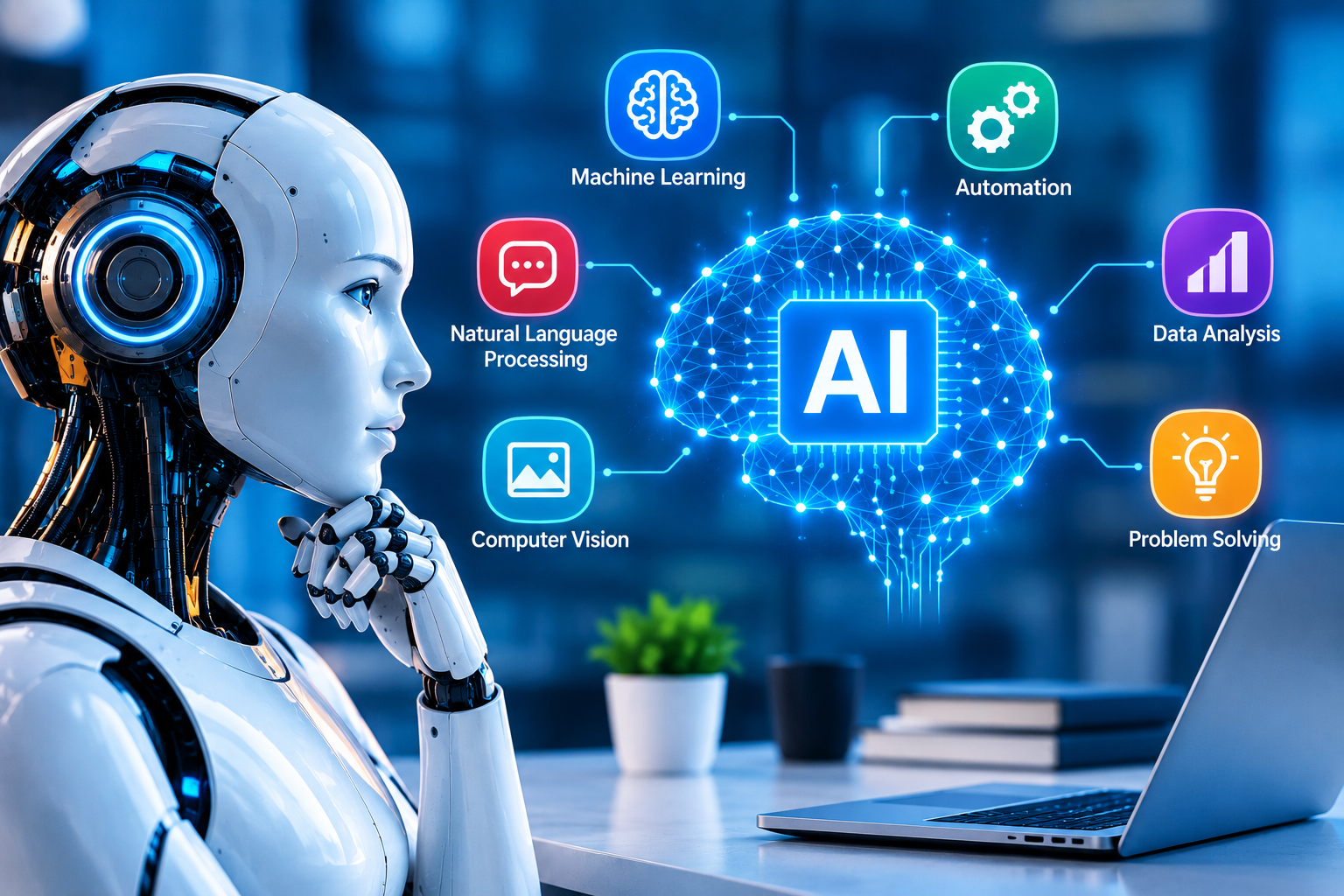
Artificial intelligence, often called AI, is one of the most important areas of modern technology. Artificial intelligence enables computer systems to perform tasks that normally require human intelligence, such as understanding language, recognizing patterns, analyzing information, and generating content. From everyday digital tools to business and scientific applications, AI is becoming an increasingly important part of modern life.
AI is already part of everyday life. People may encounter it when using search engines, translation tools, recommendation systems, navigation applications, customer-service chatbots, or productivity software.
Understanding artificial intelligence is useful for anyone who wants to keep up with changes in technology. However, AI is not perfect. It has limitations, can produce incorrect information, and raises important questions about privacy, security, employment, and responsible use.
How to leaning, Artificial Intelligence?
Artificial intelligence is a field of computer science focused on creating systems that can perform tasks associated with human intelligence.
These systems can process information, identify patterns, make predictions, and sometimes generate new content. Different AI systems are designed for different purposes, so there is no single way that all artificial intelligence works.
For example, an AI system designed to recognize objects in images works differently from one designed to translate languages or generate text.
How Does Artificial Intelligence Work?
Many modern AI systems use algorithms and large amounts of data to identify patterns.
A simplified process can look like this:
- Data is collected for a specific purpose.
- A model is trained to identify useful patterns in that data.
- The model is tested to evaluate how well it performs.
- The system receives new information and produces an output based on what it learned.
- People monitor and improve the system when necessary.
Machine learning is an important part of modern AI. Instead of programming every possible response manually, developers can train models to recognize patterns from examples.
Generative AI
Generative AI is a type of artificial intelligence that can create new content based on instructions or inputs.
Depending on the system, it may generate text, images, audio, computer code, or other forms of content.
Generative AI can be useful for brainstorming, drafting, summarizing, learning, and creative projects. However, users should review generated content because AI can sometimes produce inaccurate or misleading information.
Common Uses of Artificial Intelligence
Artificial intelligence is used across many industries and activities.
Education
AI can help students organize information, practice concepts, explain difficult topics, and generate study materials. Teachers and educational organizations can also use AI tools for certain administrative and instructional tasks.
AI should support learning rather than replace critical thinking. Students should understand information instead of simply accepting automatically generated answers.
Business
Businesses can use AI to analyze information, automate repetitive tasks, assist customers, and improve workflows.
For example, an organization might use an AI-powered system to classify customer questions before sending them to the appropriate department.
Healthcare
AI can assist professionals with tasks such as analyzing information, organizing records, and supporting certain research and diagnostic processes.
Because healthcare decisions can have serious consequences, AI-generated information should not automatically be treated as professional medical advice.
Transportation
AI can be used in navigation, traffic analysis, logistics, and vehicle-related technologies. These systems can process information from multiple sources to help identify patterns and support decisions.
Entertainment
Streaming services and other digital platforms may use algorithms to recommend movies, music, videos, or other content based on user activity and preferences.
Benefits of Artificial Intelligence
When used responsibly, artificial intelligence can provide several advantages.
Increased Efficiency
AI can process large amounts of information quickly and help automate repetitive tasks. This can allow people to spend more time on work that requires judgment, creativity, or communication.
Improved Accessibility
AI-powered tools can assist with translation, speech recognition, text generation, and other functions that may make digital services easier to use for different people.
Data Analysis
AI can identify patterns in large datasets that may be difficult to find manually. This can help organizations make better-informed decisions when the underlying data is reliable.
Personalization
AI can help digital services provide more personalized recommendations, learning experiences, and content.
Limitations and Risks of AI
Limitations and Risks of AI
Artificial intelligence also has important limitations.
AI Can Make Mistakes
An AI system can produce an answer that sounds convincing but is incorrect. This is especially important when dealing with legal, financial, medical, or other high-stakes information.
Users should verify important information through reliable sources.
Privacy Concerns
AI systems may process significant amounts of information. Organizations and users should understand what data is collected, how it is used, and what privacy protections are available.
Bias
AI systems can reflect problems or biases contained in their training data or design. Careful testing and human oversight are important when AI is used for decisions that affect people.
For more guidance on identifying and managing AI-related risks, see the NIST AI Risk Management Framework.
also there are anather plan you can use so that can help you to enhance your knowledge of AI.
there is on article that plan , chlick here to read https://kaskeymarketer.com/technology-a-complete-guide-to-modern-technology-and-how-it-works/
Changes to Jobs
AI can automate some tasks and change how certain jobs are performed. At the same time, it can create demand for new skills and new types of work.
The effect of AI on employment will vary across industries and occupations.Artificial intelligence also has important limitations.
AI Can Make Mistakes
An AI system can produce an answer that sounds convincing but is incorrect. This is especially important when dealing with legal, financial, medical, or other high-stakes information.
Users should verify important information through reliable sources.
Privacy Concerns
AI systems may process significant amounts of information. Organizations and users should understand what data is collected, how it is used, and what privacy protections are available.
Bias
AI systems can reflect problems or biases contained in their training data or design. Careful testing and human oversight are important when AI is used for decisions that affect people.
Changes to Jobs
AI can automate some tasks and change how certain jobs are performed. At the same time, it can create demand for new skills and new types of work.
The effect of AI on employment will vary across industries and occupations.
How to Use Artificial Intelligence Responsibly
People can make better use of AI by following a few simple principles:
- Verify important information.
- Avoid entering sensitive personal information into tools unless you understand their privacy practices.
- Use AI as an assistant rather than blindly accepting every answer.
- Review AI-generated content before publishing or sharing it.
- Keep human judgment involved in important decisions.
- Follow the rules and policies of the AI service you use.
Responsible use is especially important when AI is used in education, business, healthcare, finance, or other areas where mistakes can have significant consequences.
Artificial Intelligence vs. Traditional Software
Traditional software generally follows rules and instructions created by programmers.
AI systems can use learned patterns to produce predictions, classifications, recommendations, or generated content.
For example, a traditional calculator follows explicit mathematical operations. An AI language model, by comparison, processes patterns in language to generate responses.
Both approaches remain useful. AI is not automatically better than conventional software for every task.
The Future of Artificial Intelligence
Artificial intelligence is likely to continue developing and becoming part of more digital products and services.
Future progress may bring better tools for research, education, communication, software development, accessibility, and business operations. At the same time, society will need to address questions involving privacy, reliability, security, copyright, employment, and responsible development.
The most useful approach is neither to assume that AI will solve every problem nor to reject it completely. Understanding its capabilities and limitations can help people use the technology more effectively.
Frequently Asked Questions
1. What is artificial intelligence in simple terms?
Artificial intelligence is technology that enables computer systems to perform tasks that can involve abilities such as learning from data, recognizing patterns, understanding language, making predictions, or generating content.
2. Is artificial intelligence the same as machine learning?
No. Machine learning is a major approach within artificial intelligence. It allows systems to learn patterns from data rather than relying only on manually written rules.
3. Can artificial intelligence replace humans?
AI can automate or assist with some tasks, but it does not mean that humans will become unnecessary. Many activities require judgment, responsibility, communication, creativity, and understanding of real-world context.
4. Is artificial intelligence always accurate?
No. AI systems can make errors or produce inaccurate information. Important information should be checked against reliable and authoritative sources.
5. Why is artificial intelligence important?
AI is important because it can help people process information, automate tasks, analyze data, and develop new digital tools. Its growing use also makes it important to understand its limitations and responsible applications.
Conclusion
Artificial intelligence is changing the way people interact with technology. From education and business to transportation and entertainment, AI can help automate tasks, analyze information, and create new possibilities.
However, artificial intelligence is not infallible. Its results can contain errors, and its use can raise questions about privacy, bias, security, and employment. The best way to benefit from AI is to understand both its strengths and its limitations.
As the technology continues to evolve, learning how to use artificial intelligence thoughtfully and responsibly will become increasingly valuable.
SEO Title: Artificial Intelligence: How AI Works, Uses, Benefits & Challenges
Focus Keyword: artificial intelligence
Meta Description: Learn how artificial intelligence works, its everyday uses, benefits, limitations, risks, and why responsible AI use matters today.
Suggested URL Slug: artificial-intelligence-guide
Related Keywords:
- AI technology
- machine learning
- generative AI
- AI applications
- benefits of artificial intelligence
- artificial intelligence examples
- AI tools
- future of AI
- AI in everyday life
- artificial intelligence explained
- responsible AI
- AI advantages and limitations