


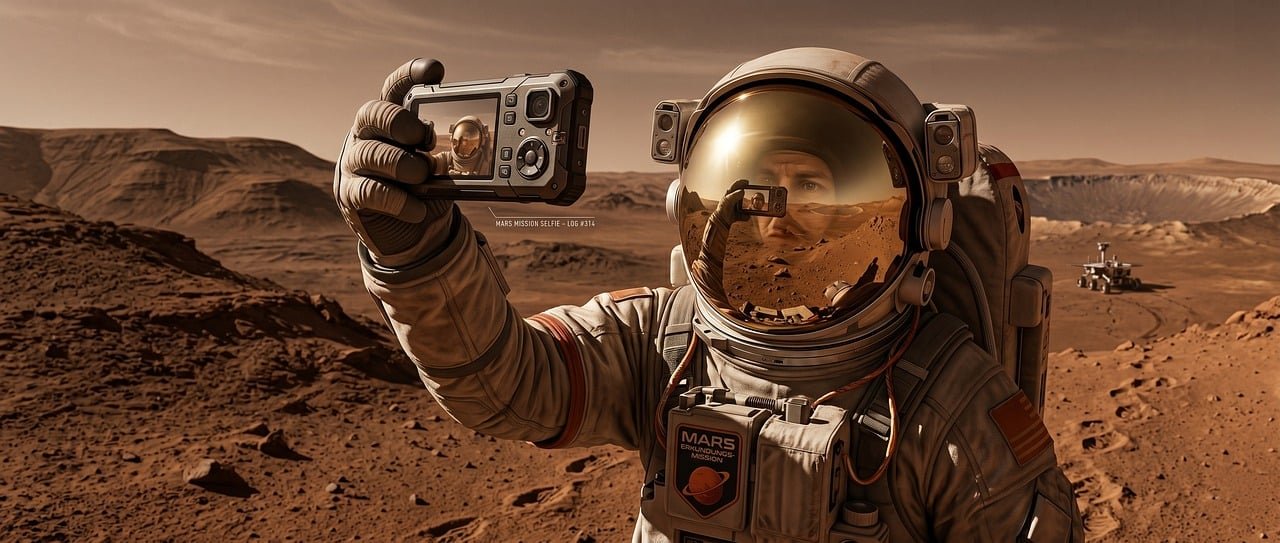
Mars is one of the most fascinating worlds in our solar system. Often called the Red Planet, Mars has captured human curiosity for centuries because of its distinctive reddish appearance, rocky landscape, polar ice, and potential to preserve evidence about ancient environments.
But what is the planet Mars actually like? How does it compare with Earth? Does Mars have water, weather, or moons? And why do scientists continue to send spacecraft and robotic explorers there?
This guide explores the planet Mars in a simple and informative way, covering its physical characteristics, atmosphere, surface, climate, moons, exploration, and the questions scientists are still investigating.
What Is the Planet Mars?
Mars is the fourth planet from the Sun and is classified as a terrestrial, or rocky, planet. Like Earth, Mercury, and Venus, it has a solid surface rather than being a gas giant.
Mars is smaller than Earth and has a much thinner atmosphere. Its surface contains mountains, valleys, plains, impact craters, and other geological features that provide clues about the planet’s long history.
One of Mars’s most recognizable characteristics is its reddish color.
Why Is Mars Red?
Mars appears red largely because iron-bearing minerals in its surface materials have undergone oxidation. The resulting iron oxides, similar in principle to rust, contribute to the reddish dust and rocks found across the planet.
Dust can also become suspended in the atmosphere, giving the Martian sky and landscape distinctive colors.
How Big Is Mars?
Mars is significantly smaller than Earth. Its diameter is roughly half that of Earth, and its lower gravity means that a person would weigh considerably less on Mars than on Earth.
Despite its smaller size, Mars has a remarkable variety of geological features.
For example, Mars is home to Olympus Mons, an enormous shield volcano, and Valles Marineris, a vast canyon system.
Mars Compared With Earth
| Feature | Mars | Earth |
|---|---|---|
| Position from the Sun | Fourth | Third |
| Type | Rocky planet | Rocky planet |
| Atmosphere | Very thin | Much thicker |
| Surface water | No stable liquid-water oceans today | Extensive liquid-water oceans |
| Natural moons | 2 | 1 |
| Day length | About 24.6 hours | About 24 hours |
| Global magnetic field | No present global field | Yes |
The comparison shows why Mars is interesting to scientists: it shares some basic characteristics with Earth while having a dramatically different environment.
What Is the Surface of Mars Like?
The surface of Mars is cold, dry, dusty, and rocky. It contains many different geological environments.
Scientists have observed ancient river channels, lake-related features, sedimentary rocks, volcanic landscapes, dunes, and impact craters.
These features are particularly important because they suggest that Mars was not always as dry and cold as it is today.
Mountains and Volcanoes
Olympus Mons is one of the most spectacular geological features on Mars. It is a giant shield volcano formed by repeated volcanic activity over a long period.
Mars also contains other large volcanic structures, especially in the Tharsis region.
Valles Marineris
Valles Marineris is an enormous canyon system near the Martian equator. It extends across a large portion of the planet’s surface and is far larger than many familiar canyon systems on Earth.
Its formation is associated with the geological history of Mars, including tectonic and volcanic processes.
Does Mars Have Water?
Yes, Mars contains water ice, particularly in its polar regions and underground deposits. Evidence from spacecraft and rovers also indicates that liquid water was much more common on ancient Mars.
Scientists have found geological features that are consistent with past flowing water, including channels and minerals that can form in watery environments.
However, Mars does not currently have Earth-like oceans, rivers, and lakes of stable liquid water on its surface.
Understanding the history of Martian water is important because water played a major role in shaping the planet’s geology and may help scientists determine whether Mars once had environments capable of supporting microbial life.
What Is the Atmosphere of Mars Like?
The atmosphere of Mars is extremely thin compared with Earth’s atmosphere. It consists mostly of carbon dioxide, with smaller amounts of other gases.
Because the atmosphere is so thin, it provides limited insulation and protection from the harsh space environment.
Mars can also experience significant dust activity. Local dust storms are common, and larger regional storms sometimes occur.
What Is the Weather Like on Mars?
Mars has seasons because its rotational axis is tilted, much like Earth’s.
The planet can experience:
- Cold temperatures
- Strong winds
- Dust storms
- Seasonal changes
- Water-ice clouds
- Frost in some regions
Temperatures vary significantly depending on location, season, and time of day.
How Long Is a Day on Mars?
A Martian solar day, called a sol, lasts about 24 hours and 39 minutes.
That is surprisingly close to an Earth day. This similarity is one reason Mars is sometimes considered relatively familiar compared with other planets in the solar system.
A Martian year, however, is much longer. Mars takes about 687 Earth days to complete one orbit around the Sun.
Does Mars Have Moons?
Mars has two small natural satellites: Phobos and Deimos.


Phobos
Phobos is the larger and closer of Mars’s two moons. It orbits extremely close to the planet and travels around Mars much faster than Mars rotates.
Deimos
Deimos is smaller and farther from Mars than Phobos. Both moons have irregular shapes and are much smaller than Earth’s Moon.
The origins of Phobos and Deimos remain an area of scientific investigation.
Why Do Scientists Explore Mars?
Mars is one of the most extensively explored planets beyond Earth.
Scientists study it for several important reasons.
1. Understanding Planetary History
Mars preserves evidence of geological processes that occurred over billions of years. Studying those processes can improve our understanding of how rocky planets develop.
2. Investigating Ancient Water
Evidence of ancient water makes Mars especially interesting. Researchers want to understand when water was present, how long it remained, and what happened to it.
3. Searching for Signs of Ancient Life
Scientists have not confirmed that life ever existed on Mars. However, because some ancient Martian environments may have been more favorable to life than today’s surface, researchers investigate rocks and minerals for possible evidence of past microbial activity.
It is important to distinguish searching for evidence from proving that life existed.
4. Preparing for Future Exploration
Robotic missions help scientists learn about Mars while testing technologies and methods that could support increasingly sophisticated exploration.
How Have Humans Explored Mars?
Humans have not yet landed on Mars. Instead, spacecraft, orbiters, landers, and robotic rovers have explored the planet.
Missions have photographed the surface, analyzed rocks and soil, studied the atmosphere, measured geological activity, and investigated the planet’s history.
Rovers such as Curiosity and Perseverance have been particularly valuable because they can move across the surface and examine geological features directly.
Why Are Mars Missions Difficult?
Mars exploration is technically challenging.
Spacecraft must travel millions of kilometers, survive launch and deep space, enter the Martian atmosphere safely, and operate in a cold, dusty environment.
Communication also takes time because signals between Earth and Mars cannot travel instantly.
These challenges mean that spacecraft require extensive planning, testing, and autonomous systems.
Could Humans Live on Mars?
Human settlement on Mars remains a major scientific and engineering challenge.
Mars lacks a breathable atmosphere and has extremely cold conditions. Its surface also receives more harmful radiation than Earth’s surface because Mars does not have the same level of atmospheric and magnetic protection.
Future human missions would therefore require sophisticated habitats, life-support systems, reliable supplies, energy sources, and protection from the environment.
It is more accurate to describe human settlement on Mars as a future possibility under investigation, rather than something that is currently practical or guaranteed.
Interesting Facts About the Planet Mars
Here are several useful facts about Mars:
- Mars is the fourth planet from the Sun.
- It is a rocky planet.
- Mars is known as the Red Planet.
- Mars has two moons: Phobos and Deimos.
- A Martian day is called a sol.
- A Martian year lasts about 687 Earth days.
- Mars has polar regions containing water ice.
- The planet has enormous volcanoes and canyon systems.
- Mars has a very thin atmosphere dominated by carbon dioxide.
- Robotic spacecraft have been studying Mars for decades.
Frequently Asked Questions
Is Mars bigger or smaller than Earth?
Mars is smaller than Earth. Its diameter is roughly half that of Earth, and its surface gravity is much weaker.
Why is the planet Mars called the Red Planet?
Mars appears reddish because iron-bearing minerals in its surface materials have oxidized, producing iron oxides that contribute to the planet’s distinctive color.
Does Mars have oxygen?
Mars contains oxygen in its atmosphere, but only in a very small proportion compared with Earth’s atmosphere. Its atmosphere is dominated by carbon dioxide and is not breathable for humans.
Can humans live on Mars?
Humans do not currently live on Mars. Long-term human habitation would require advanced habitats, life-support systems, radiation protection, reliable resources, and other technologies.
Has life been found on Mars?
No confirmed evidence of life on Mars has been established. Scientists continue studying Martian rocks, soil, and environmental history for possible signs of ancient microbial life.
Conclusion
The planet Mars is a fascinating rocky world with a complex geological history. Its ancient water-related features, enormous volcanoes, deep canyon systems, thin atmosphere, two unusual moons, and changing climate make it one of the most important destinations for planetary science.
Although Mars is very different from Earth, studying it can help scientists understand how planets evolve and how environments can change over time. Future missions may reveal more about Mars’s past and help answer one of science’s biggest questions: whether life ever existed beyond Earth.
For readers interested in space, Mars offers an excellent starting point for learning about planetary science, exploration, and the history of our solar system.
SEO Information
SEO Title: The Planet Mars Explained: Everything You Need to Know
Focus Keyword: the planet mars
Meta Description: Discover the planet Mars, including its surface, atmosphere, moons, climate, water, exploration, and the search for signs of ancient life.
Suggested URL Slug: the-planet-mars-explained
Related Keywords:
- Mars facts
- Red Planet
- Mars surface
- Mars atmosphere
- Mars moons
- Mars climate
- Mars exploration
- water on Mars
- Mars compared to Earth
- life on Mars
- Mars geology
- Mars missions